If you have been eyeing Bothell for your first small multifamily investment, you are not alone. The city has meaningful renter demand, a growing population, and housing rules that are changing how duplexes, triplexes, and fourplexes fit into the local market. If you want a clearer picture of where the opportunity is, what can trip up a deal, and how to evaluate a property with more confidence, you are in the right place. Let’s dive in.
Why Bothell stands out
Bothell is still a largely low-density city, but it is growing. The city estimates its population at 49,550 as of April 2023, up 19% since the 2014 annexation. That matters because growth tends to put steady pressure on housing demand over time.
The renter base is also substantial. Bothell reports that 35% of households rent and 65% own, across roughly 20,824 housing units citywide. For a small investor, that points to a real rental market rather than a purely owner-occupied landscape.
The current housing mix is another key part of the story. About 52% of Bothell’s housing units are single-family homes, while 34% are apartments or other multifamily buildings with five or more units. That leaves room for smaller middle-housing formats to play a bigger role.
Why small multifamily matters now
Bothell has an adopted target of 12,782 new housing units from 2020 through 2044. The city has also said that missing growth targets can affect state funding eligibility. In other words, adding housing is not just a private market trend. It is part of a broader city planning goal.
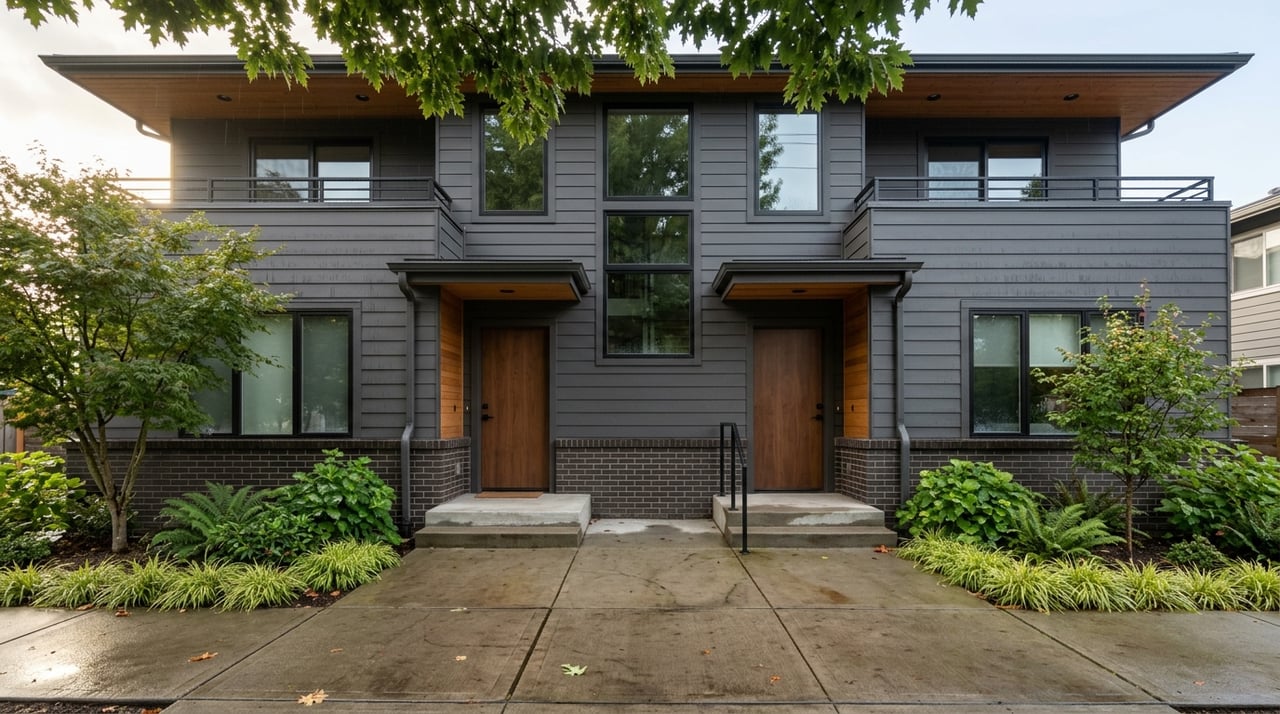
That is one reason duplexes, triplexes, and fourplexes deserve a closer look. They fit into what Bothell describes as middle housing, which includes house-scale forms intended to work within residential neighborhoods. The city also notes that this type of housing can support increased density, walkability, affordability, and a more compact urban form.
For you as an investor, that creates an important mindset shift. Small multifamily in Bothell should be viewed as part of a changing housing strategy, not as a product type that will automatically work on every lot. The opportunity is real, but parcel-level details matter.
What the zoning changes mean
Washington’s middle-housing law changed the baseline for cities like Bothell. Under state law, cities in Bothell’s population range must allow at least two units per lot on predominantly residential lots, up to four units within a quarter-mile walking distance of a major transit stop, and potentially more units when affordability conditions are met.
Bothell’s local rules have also moved in that direction. The city’s December 2024 technical appendix says Ordinance 2415 allows middle housing in all residential zones, with the 2-to-4 unit range tied to transit proximity and affordability. Bothell’s permit center says those zoning code amendments took effect on January 1, 2025.
That is encouraging for investors, but it does not remove the need for verification. A lot may look like a strong candidate on paper, yet the actual unit count can still depend on location, access, lot characteristics, and other live zoning details.
Corner lots deserve attention
One local detail stands out. Bothell’s middle-housing page says duplexes are allowed on corner lots in all residential zones. If you are scanning the market for an easier entry point, corner parcels are worth a second look.
That does not mean every corner lot is a perfect duplex site. It does mean those properties may offer clearer small multifamily potential than an interior lot with similar size and price. In a market where zoning nuance matters, that can be a useful filter.
Transit proximity can change feasibility
Transit access is another major variable. State law requires cities to allow up to four units within a quarter-mile walking distance of a major transit stop, and it also limits off-street parking requirements within one-half mile of a major transit stop.
That can improve feasibility in the right location. Fewer parking constraints may help a site fit more units or reduce development cost. Outside those transit-influenced areas, local parking standards can still affect what works, so you should not assume every lot pencils the same way.
How to check a property the right way
Before you get attached to a pro forma, verify the parcel. Bothell directs users to COBMap for current zoning and says printed maps are informational only and carry no guarantee of accuracy. The city also notes that permit and land-use applications are handled online.
This is one of the most important early steps you can take. A property search should include more than list price, unit count potential, and neighborhood feel. You want to confirm current zoning, transit proximity, environmental layers, and approximate property boundaries before you make assumptions.
A practical starting checklist includes:
- Confirm the parcel’s current zoning in COBMap
- Check whether the property is near a major transit stop
- Review environmental layers and any visible site constraints
- Ask whether tree removal may be needed
- Look into existing building plans, plat maps, ordinances, or resolutions through the city’s online records
- Remember that approximate boundaries are not a substitute for a survey
How to underwrite a Bothell small multifamily deal
A lot of first-time investors make the same mistake. They focus on purchase price, mortgage payment, and maybe property taxes, then assume the rest will sort itself out. In Bothell, that shortcut can create expensive surprises.
For rent context, Zillow reported an average rent of $2,455 in April 2026, and Apartment List reported a median rent of $2,400 in June 2026. HUD Fair Market Rents for the Seattle-Bellevue metro area can also serve as a broad backstop because they estimate gross rent, including shelter plus tenant-paid utilities except phone, cable, and internet.
Those figures are useful, but they are only the top line. You still need to stress-test income against vacancy, repairs, maintenance, insurance, taxes, utilities you may cover, and management if applicable. Then in Bothell, you also need to pay close attention to site and permit costs.
Local costs can change the math fast
Bothell’s permit center says permit costs for new construction and additions vary by square footage and construction type, with additional fees possible. The city also flags tree removal, critical areas, and existing-record searches as due diligence items. That means a deal that looks attractive based on rent alone may become much less appealing once site work is understood.
Tree removal can trigger permit requirements, arborist review, replanting obligations, or critical-area review. Stormwater matters too. Bothell performs annual stormwater inspections on private systems and can require maintenance or repairs after inspection.
That is why a realistic underwriting model should include a full expense stack, not just the obvious line items. Drainage, site preparation, impervious-cover limits, and permit-related costs can affect both your budget and the number of units a lot can reasonably support.
A simple underwriting mindset
When you analyze a duplex, triplex, or fourplex in Bothell, think in layers:
- Income potential based on current local rents and realistic vacancy.
- Base ownership costs such as financing, taxes, insurance, and routine maintenance.
- Operational reserves for repairs, turnover, and ongoing upkeep.
- Site-specific costs including tree, stormwater, and possible critical-area issues.
- Permit and timeline risk if your plan involves additions, redevelopment, or layout changes.
If the deal still works after those layers, you are looking at a much stronger opportunity.
Policy and management issues to watch
Bothell is considering renter-protection measures such as longer notice periods for rent increases, caps on move-in fees and security deposits, and better fee disclosure. The city has also stated that rent control is prohibited by statute and is not being considered.
For an investor, that means the policy conversation is less about direct rent caps and more about operating rules around notice and fees. Those details can affect cash flow, leasing practices, and how you set expectations from day one.
It is also important to know what the city does not handle. Bothell’s code-compliance page says the city does not manage landlord-tenant disputes. Issues involving lease enforcement, habitability, or eviction should be treated as Washington Residential Landlord-Tenant Act matters and handled with appropriate legal guidance.
A practical way to get started
If you are new to small multifamily investing in Bothell, try not to underwrite from the couch for too long. This is a market where local rules, parcel details, and site conditions can make a major difference. A property that seems average at first glance may have real upside, while a property that looks exciting online may carry hidden cost.
A smart first move is to narrow your search to lots with a clear reason to investigate further. That may include corner parcels, sites near major transit stops, or properties where the existing layout and lot characteristics appear to support middle housing under current rules.
Then move from broad market interest to parcel-specific diligence. Verify the zoning, review the map layers, stress-test the rents, and build in room for site and permit costs. That slower, more informed approach is often what separates a solid investment from an expensive lesson.
If you want help identifying Bothell opportunities and sorting through the local trade-offs with a calm, data-driven approach, The Greely Group can help you evaluate the market and move forward with more clarity.
FAQs
What makes Bothell appealing for small multifamily investing?
- Bothell combines population growth, a sizable renter share, and active housing-policy changes that support more middle-housing options like duplexes, triplexes, and fourplexes.
Can every residential lot in Bothell support a duplex or fourplex?
- No. State and local rules support more middle housing, but the actual unit count depends on parcel-specific factors such as zoning, transit proximity, and site conditions.
How do you check if a Bothell lot can hold more units?
- Start with COBMap to confirm current zoning, review transit proximity and environmental layers, and then verify parcel-specific details with the city before making assumptions.
Why are corner lots important for Bothell duplex investors?
- Bothell says duplexes are allowed on corner lots in all residential zones, which can make those parcels especially worth reviewing for small multifamily potential.
How should you estimate rent for a Bothell duplex, triplex, or fourplex?
- Use current Bothell rent data as a starting point, compare it against broader fair market rent context, and then stress-test the numbers with realistic vacancy and expenses.
What local costs can hurt a Bothell multifamily deal?
- Tree removal, critical-area review, stormwater requirements, permit fees, and site-preparation issues can all increase cost and affect timeline or feasibility.
Are parking rules a big factor for Bothell middle housing?
- Yes. Parking can affect feasibility, especially outside transit-served areas, while state law limits off-street parking requirements within one-half mile of a major transit stop.
Does the City of Bothell handle landlord-tenant disputes?
- No. The city says landlord-tenant disputes are not handled through code compliance, so lease, habitability, and eviction issues should be addressed under Washington law with legal guidance.
What renter-protection changes should Bothell investors watch?
- The city is considering items like longer rent-increase notice periods, fee disclosure rules, and limits on move-in fees or deposits, which could affect leasing practices and operations.